Blog
Trestly Brings kUSDT to Kaspa Layer 1: What It Is and How It Works
Trestly has launched kUSDT on Kaspa mainnet: a token on Kaspa Layer 1 backed 1:1 by USDT locked on Ethereum and BNB Chain. Its mainnet rollout began on 15 November 2026. Here's what it is, how it works, what it costs, and the risks to understand before using it.
What is Trestly?
 Trestly · kUSDT bridge, KasPool and kUSDT Wallet
Telegram · X
Trestly is a bridge between Ethereum, BNB Chain and Kaspa. You lock USDT in a vault contract on Ethereum or BNB Chain, and Trestly issues the same amount of kUSDT on Kaspa, minus fees. Send kUSDT back to the bridge and the vault releases USDT to your EVM address.
The project has three main parts:
- The bridge (deposits, mints and redemptions)
- KasPool, a swap pool for trading KAS and kUSDT directly on Kaspa
- kUSDT Wallet, a browser extension that signs the Kaspa-side transactions
Note that kUSDT is not issued by Tether. It is a separate token whose value depends on the USDT held in Trestly's vaults.
Why it matters for Kaspa
Stablecoins are among the most used assets in crypto, and they're the base for most trading and payments. Until now, Kaspa had no practical way to hold a dollar-pegged token on its own Layer 1.
kUSDT is possible because of the Toccata hard fork in June 2026, which added native covenants to Kaspa. Covenants are scripts that control how a coin can be spent. Trestly uses them to enforce token rules, so every kUSDT balance is an ordinary Kaspa UTXO that only accepts valid token moves. The token follows the standard KCC-20 format, so wallets and indexers that support KCC-20 can read it.
Because kUSDT lives on Layer 1, transfers and swaps are normal Kaspa transactions. They get Kaspa's 10 blocks per second and fast confirmations, and pay small fees in KAS. Track Toccata and other forks on our upgrade tracker.
How the bridge works
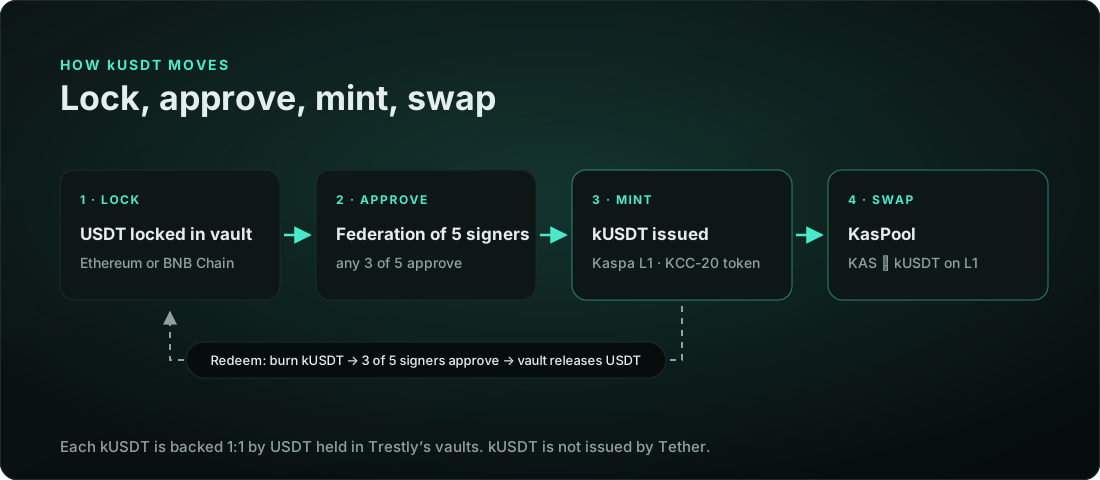
- Deposit. You lock USDT in Trestly's vault on Ethereum or BNB Chain and name your Kaspa address.
- Approve. Five independent signers watch the deposit. Once it's final, at least three must approve it.
- Mint. A covenant on Kaspa checks the signatures and daily limits, then issues your kUSDT.
- Redeem. To go back, you burn kUSDT and name your EVM address. Signers approve, and the vault pays out USDT.
KasPool: swapping KAS and kUSDT
KasPool is a constant-product pool, the same model as Uniswap, running as covenants on Kaspa L1. Each swap happens in a single Kaspa transaction, so it either completes fully or not at all. Users can also add liquidity and earn a share of swap fees.
Fees and limits at launch
- Bridging in: 0.50% (minimum 0.50 USDT), rising to as much as 2.50% when deposit volume is heavy.
- Redeeming: a flat 0.50%, with minimum redemptions of 1,000 USDT on Ethereum and 100 on BNB Chain.
- Swaps on KasPool: 0.50% per swap, with 0.45% going to liquidity providers and 0.05% to the protocol.
- Limits: deposits of up to 8,000 USDT each, a Kaspa mint allowance of 100,000 USDT per 24 hours, and vault releases of 50,000 USDT per vault per day.
- Kaspa network fees: paid in KAS. Each kUSDT balance also carries about 1.5 KAS for storage, which stays with the balance.
The risks
Trestly is open about its trust model, and it's worth reading before you bridge anything:
- Not yet audited. Trestly says no independent audit has been done. Four outside reviews were completed, but it doesn't count them as audits. The legal review is also still open.
- A federated bridge. Security depends on no three of the five signers colluding. Daily caps, time delays and a guardian key that can pause the system limit the damage if something goes wrong.
- Tether controls. Tether can blacklist addresses on Ethereum, which could block a payout to that address.
- Fake addresses. Only use the contract and covenant addresses listed on Trestly's official status page.
Trestly's own advice: bridge only what you can afford to lose. Over time, it plans to replace signer approvals with zero-knowledge proofs that verify deposits on-chain.
Frequently asked questions
Is kUSDT the same as USDT?
No. kUSDT is a separate token on Kaspa, backed 1:1 by USDT held in Trestly's vaults. It isn't issued by Tether.
Which wallet do I need?
The kUSDT Wallet browser extension handles Kaspa-side transactions. For deposits, you use your usual EVM wallet on Ethereum or BNB Chain.
Has Trestly been audited?
Not yet. An external audit is on its roadmap.
Where can I learn more?
Read Trestly's documentation at trestly.io/docs, or follow its Telegram channel and X account.
Not financial advice. This article is for education only and is not an endorsement. dagknight.com is not affiliated with Trestly or the Kaspa Foundation. Figures are taken from Trestly's documentation as of 16 November 2026 and may change. Trestly logo and artwork from Trestly's media kit.