Blog
DAGKnight Status Update (November 2026): Where It Stands
Short answer: DAGKnight is not live yet. As of November 2026, Kaspa still runs on GHOSTDAG. DAGKnight is being implemented in the Rust node, parts of it are in code review, and no testnet or mainnet date has been announced. Here's what has happened so far and what comes next.
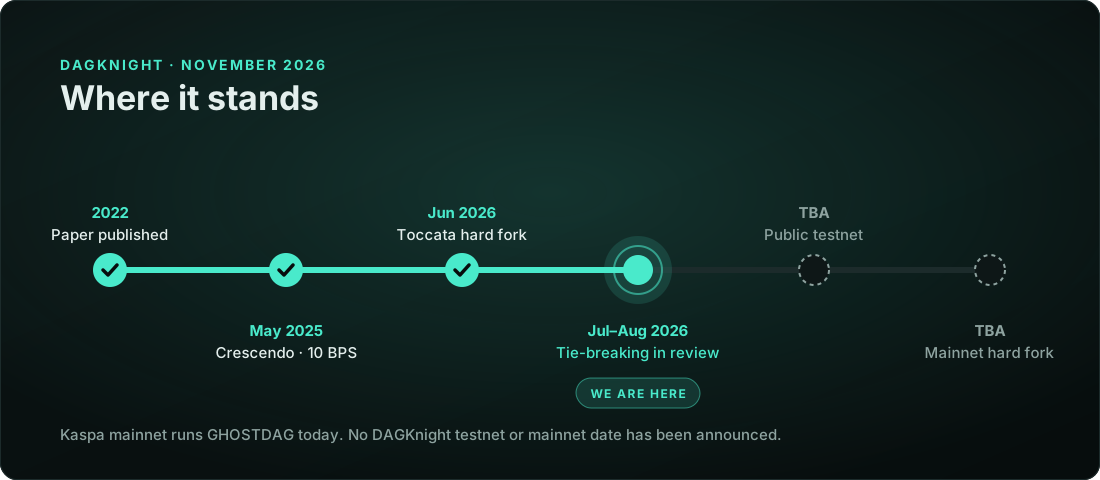
Where things stand
- Mainnet consensus: GHOSTDAG, at 10 blocks per second.
- DAGKnight code: being built on a dedicated
dagknightbranch of rusty-kaspa, Kaspa's Rust full node. - Latest milestone: the tie-breaking rule went into code review in mid-2026 (details below).
- Testnet: proposed, no date announced.
- Mainnet: no date announced. Activating it will need a hard fork.
How we got here
- 2022: Michael Sutton and Yonatan Sompolinsky publish the DAGKnight paper and its security proofs.
- 2023–24: Kaspa's full node is rewritten in Rust (rusty-kaspa). This is the codebase DAGKnight is being built in.
- May 2025: the Crescendo hard fork raises Kaspa from 1 to 10 blocks per second. Consensus stays on GHOSTDAG.
- 30 June 2026: the Toccata hard fork activates, adding native Layer 1 covenants and zero-knowledge proof verification. DAGKnight is widely seen as the next major consensus change after it.
- July–August 2026: tie-breaking code is proposed on the
dagknightbranch and enters review.
You can follow every past and planned fork on our Kaspa upgrade tracker.
What's in code review: the tie-breaking rule
DAGKnight works by searching for the smallest setting (k) at which the majority of mining work forms a well-connected cluster. (Our parameterless consensus explainer covers this in plain English.) Sometimes that search ends in a tie: several competing groups of blocks qualify at the same k. The protocol needs a rule to pick one.
Until recently, the branch used a temporary placeholder rule. On 27 July 2026, Kaspa developer coderofstuff opened a pull request (#1081) implementing the paper's tie-breaking procedure, and Kaspa News reported on it on 11 August 2026. According to that report:
- The code sits behind a separate tie-breaker component, with unit tests and benchmarks.
- It was proposed feature-branch code, not merged into the main branch.
- Some automated checks had not yet passed, and one part of the paper's procedure was still marked as a to-do.
In other words, this is real implementation progress, but it is not a release and not a hard-fork date.
What has to happen before mainnet
Based on how Kaspa's previous upgrades rolled out, the likely path is:
- Finish and review the code, including the full tie-breaking procedure.
- Merge into the main node codebase behind an activation switch.
- Run a public testnet so node operators, miners, wallets and exchanges can test it.
- Announce a hard fork with an activation point (a DAA score, as with Crescendo and Toccata).
- Node and pool upgrades before the activation point.
Some roadmap write-ups have placed DAGKnight anywhere from 2026 to 2027, sometimes alongside other features. None of these are official dates, so treat any specific date you see with caution until the Kaspa developers announce one.
Frequently asked questions
Is DAGKnight live on Kaspa?
No. Kaspa mainnet runs GHOSTDAG. DAGKnight is in development.
When will DAGKnight launch?
No date has been announced. A testnet is expected to come first, then a hard fork.
Do I need to do anything with my KAS?
No. Consensus upgrades happen at the node level. DAGKnight doesn't change the KAS supply or mining algorithm. Be wary of anyone asking you to "migrate" or "upgrade" your coins, which is a common scam.
Where can I watch progress?
The rusty-kaspa repository on GitHub, and our upgrade tracker, which we update as milestones happen.
Not financial advice. This article is for education only. Information is current as of 14 November 2026. dagknight.com is a community project and is not affiliated with the Kaspa Foundation.