Blog
What "Parameterless" Means in DAGKnight, Explained Simply
DAGKnight is often described with one word that sounds more complicated than it is: parameterless. It is the main idea that separates DAGKnight from GHOSTDAG, the consensus protocol Kaspa runs today. This guide explains what it means, why it matters, and where its limits are.
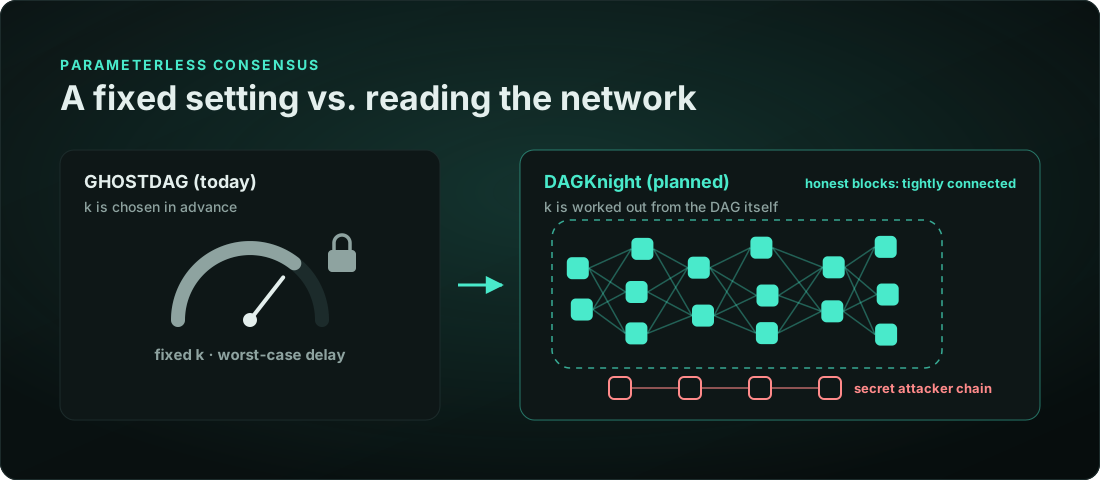
The problem: a fixed setting chosen in advance
Kaspa produces 10 blocks per second. At that speed, many blocks are mined at almost the same moment, before miners have seen each other's work. Kaspa keeps those blocks in a blockDAG instead of throwing them away, and a consensus protocol decides how to order them.
GHOSTDAG does this with a fixed number called k. Roughly, k says how many blocks can be created "in parallel" by honest miners, given the slowest network delay the protocol is designed to tolerate. That delay bound is chosen ahead of time and built into the protocol.
A useful comparison is a speed limit set before anyone has seen the road:
- Set k too low and honest blocks on a slow day can look like an attacker's, which weakens security.
- Set k too high and the protocol plays it safe all the time, so confirmations wait longer than they need to on a normal, fast day.
GHOSTDAG is secure as long as real network delay stays inside the bound it was designed for. The cost is that confirmation times are paced by the worst case, not by how the network is actually behaving.
What DAGKnight does instead
DAGKnight removes that hard-coded bound. Rather than being told k, it works k out from the DAG itself. In simplified terms, it looks for the smallest k at which blocks backed by a majority of the mining work form a well-connected cluster.
That works because of how honest and attacking blocks look in the DAG:
- Honest miners publish their blocks straight away, so their blocks reference each other and form a tight, well-connected group.
- An attacker mining in secret can't reference blocks it hasn't seen, so its blocks are poorly connected to the honest group.
When the network is healthy, the honest cluster is tight and a small k is enough. When the network slows down, the honest cluster spreads out and DAGKnight finds a larger k. Either way, the setting reflects current conditions rather than a guess made years earlier.
Why "parameterless" matters
The DAGKnight paper, by Michael Sutton and Yonatan Sompolinsky (2022), describes it as the first permissionless protocol with no built-in bound on network latency. The practical benefits it points to are:
- Adaptive confirmations. Confirmation times can follow real network conditions: quicker when the network is fast, more cautious when it struggles.
- Security without a latency guess. The paper claims security against attackers with less than 50% of the hashrate, the same threshold as Bitcoin's Nakamoto consensus, without relying on a fixed delay assumption in the protocol.
- Room to scale. A fixed k has to be re-chosen whenever block rates or network conditions change. A protocol that adapts on its own is better suited to future increases in block rate. (More on that in our article on DAGKnight and 100 BPS.)
The fine print
"Parameterless" doesn't mean there are no assumptions anywhere. The paper notes that, because of a known impossibility result in distributed systems, a client (for example, a wallet or exchange deciding when a payment is final) still has to choose a local bound on recent attacker latency. The difference is that this choice sits with the user rather than being fixed for the whole network.
It's also worth being clear about what DAGKnight is not:
- It is not live yet. Kaspa runs GHOSTDAG today, and DAGKnight is still being implemented and reviewed. See our 2026 status update.
- It doesn't change mining. Kaspa stays proof of work using kHeavyHash.
- It doesn't change KAS supply or the emission schedule.
- Real-world security depends on the implementation as well as the paper's proofs.
Frequently asked questions
Is DAGKnight just GHOSTDAG with a bigger k?
No. GHOSTDAG uses one fixed k for everyone. DAGKnight searches for the right k based on what the DAG shows, so the value can change with network conditions.
Will parameterless consensus make Kaspa faster?
Its main benefit is faster, adaptive confirmation on normal days. The number of blocks per second is a separate setting. You can estimate today's confirmation times with our confirmation time calculator.
Who designed DAGKnight?
Yonatan Sompolinsky and Michael Sutton. Sompolinsky also co-authored GHOSTDAG and the original GHOST protocol.
Not financial advice. This article is for education only. dagknight.com is a community project and is not affiliated with the Kaspa Foundation.