Blog
DAGKnight and 100 Blocks Per Second: How Kaspa Could Go Faster
Kaspa already produces 10 blocks per second (BPS), far more than most proof-of-work networks. Roadmap discussions point to going further, with 100 BPS often mentioned as a long-term target. DAGKnight comes up in almost every one of those conversations. This article explains why, and what else would have to fall into place.
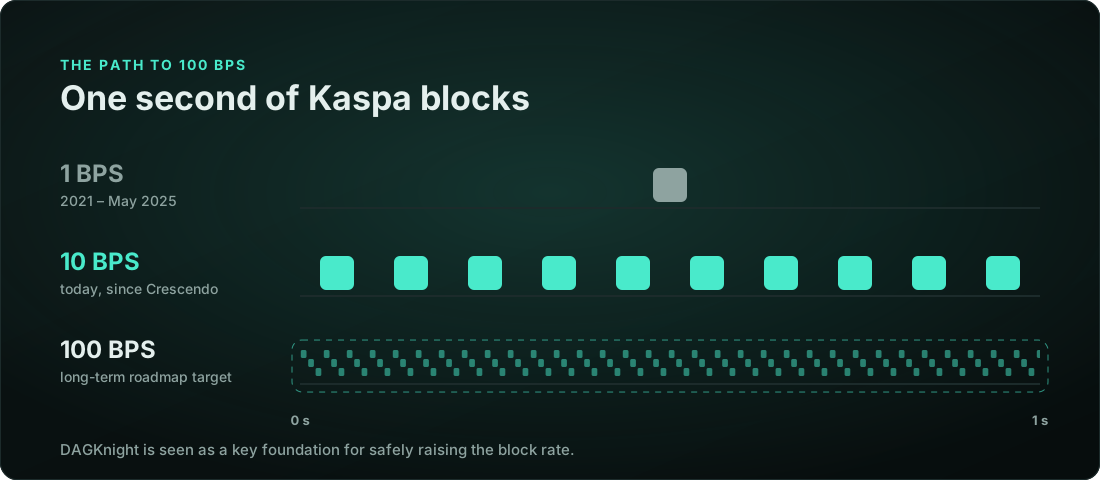
Where Kaspa is today
- 1 BPS from launch in 2021 until May 2025.
- 10 BPS since the Crescendo hard fork in May 2025, with per-block rewards scaled down so the overall emission schedule didn't change.
- Consensus: still GHOSTDAG.
Community roadmap write-ups describe stepping up gradually, for example to 25 and 40 BPS before 100. These are discussion points rather than scheduled releases, and no increase beyond 10 BPS has an announced activation date.
Why block rate and consensus are linked
The faster blocks are produced, the more of them are mined at the same moment before miners can see each other's work. A blockDAG keeps all of those parallel blocks, but the consensus protocol still has to order them and tell honest parallel blocks apart from an attacker's.
GHOSTDAG does this with a fixed setting, k, which reflects how many parallel blocks honest miners can produce given an assumed worst-case network delay. Higher block rates mean more parallel blocks within the same delay, so k has to grow with the block rate. Because k is fixed in advance, it has to be chosen conservatively for the worst case, and confirmations are paced by that assumption.
Where DAGKnight fits in
DAGKnight doesn't use a preset k. It reads the DAG and works out the right value from how well-connected the majority's blocks actually are (see what "parameterless" means). For higher block rates, that matters in three ways:
- No need to guess a new worst case for each step. Each BPS increase under GHOSTDAG means re-choosing k. DAGKnight adapts on its own.
- Confirmations follow real conditions. On a healthy network, confirmations aren't held back by worst-case assumptions, which becomes more valuable as more blocks arrive per second.
- Security without a fixed latency bound. The DAGKnight paper claims security against attackers below 50% of hashrate without a hard-coded delay assumption.
That's why many roadmap discussions treat DAGKnight as an important foundation for reaching 100 BPS safely. Exactly which steps need DAGKnight first hasn't been officially set out.
What else has to change
Consensus is only one part of the problem. Ten times more blocks per second also means:
- Faster block propagation between nodes worldwide, so parallel blocks stay well connected.
- More processing and bandwidth for nodes, while keeping it practical for ordinary people to run one.
- Storage management through Kaspa's pruning, so node disk use doesn't grow out of control.
- Miners, pools, wallets and exchanges upgrading and testing, as they did for Crescendo.
Each step is expected to go through testnets before any hard fork, as Crescendo did.
What 100 BPS would mean, and what it wouldn't
- More frequent blocks and more capacity for transactions.
- No change to total supply. If Crescendo is a guide, per-block rewards would be scaled down again so emission per second stays on schedule.
- Same proof of work. Mining stays on kHeavyHash.
- No guarantee of price impact. Network upgrades are technical changes, not price events.
Frequently asked questions
Does DAGKnight increase the block rate by itself?
No. Block rate is a separate setting changed by hard fork. DAGKnight changes how blocks are ordered and confirmed, which makes higher rates easier to support securely.
When will Kaspa reach 100 BPS?
There's no announced date. Some roadmap write-ups mention 2027 as a target, but treat that as unofficial until the developers announce a hard fork.
How fast are Kaspa confirmations now?
Try our confirmation time calculator, or watch live block rates on our live dashboard.
Not financial advice. This article is for education only. Roadmap targets can change. dagknight.com is a community project and is not affiliated with the Kaspa Foundation.