Blog
DAGKnight vs Bitcoin's Nakamoto Consensus: Same 50% Security, Very Different Speed
The DAGKnight paper's full title is A Parameterless Generalization of Nakamoto Consensus. In other words, DAGKnight is designed as an extension of the same idea that secures Bitcoin, not a replacement for it. This article compares the two: what they share, where they differ, and why it matters.
A quick refresher: how Nakamoto consensus works
Bitcoin's consensus, named after its creator Satoshi Nakamoto, is simple:
- Miners compete to find a block roughly every 10 minutes.
- Each block points to one parent, forming a single chain.
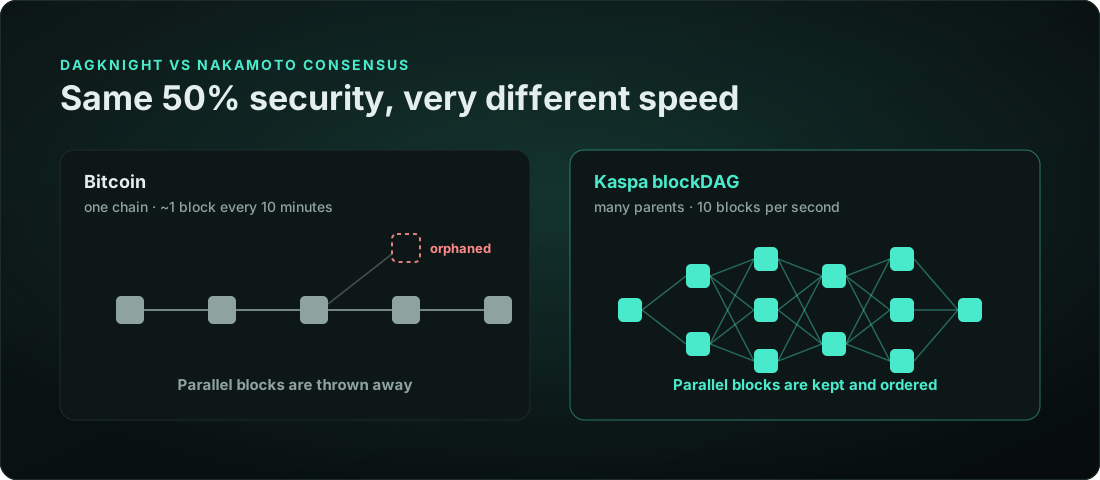
- If two blocks are found at nearly the same time, only one survives. The other is orphaned and its work is wasted.
- Everyone follows the chain with the most accumulated proof of work.
That design is very secure, but it forces Bitcoin to keep blocks slow. If blocks came much faster, more would be found at the same time, more would be orphaned, and security would suffer. Merchants also wait for several confirmations; a common convention is six, or about an hour.
What DAGKnight keeps from Bitcoin
- Proof of work. Kaspa is mined, just like Bitcoin. It uses a different algorithm, kHeavyHash, rather than SHA-256.
- The 50% threshold. The DAGKnight paper claims security against attackers controlling less than 50% of the hashrate, the same bound as Nakamoto consensus.
- Open participation. Anyone can mine or run a node without permission.
- "Most work wins." Both ultimately side with the honest majority of mining power.
What's different
| Bitcoin (Nakamoto) | Kaspa with DAGKnight (planned) | |
|---|---|---|
| Structure | Single chain | blockDAG: blocks can have many parents |
| Parallel blocks | Orphaned and discarded | Kept and ordered |
| Block rate | About 1 every 10 minutes | 10 per second today, with higher rates discussed |
| Latency assumption | Safe because blocks are slow relative to network delay | No fixed delay bound in the protocol; adapts to real conditions |
| Confirmations | Paced by the 10-minute block time | Designed to follow actual network speed |
| Security threshold | Below 50% of hashrate | Below 50% of hashrate (per the paper) |
The key shift is how parallel blocks are handled. Bitcoin avoids them by being slow. A blockDAG embraces them: every block can reference all the tips its miner has seen, so honest blocks mined at the same moment all count. The consensus protocol's job is then to put them in one agreed order.
Why that's hard, and how DAGKnight does it
Keeping every block creates a new problem: an attacker's blocks are kept too. The protocol needs to tell honest parallel blocks apart from an attacker's hidden chain.
Kaspa's current protocol, GHOSTDAG, does this with a fixed setting (k) based on an assumed worst-case network delay. DAGKnight goes further: it works out the right setting from the DAG itself, by looking for the group of blocks backed by a majority of the work that is most tightly connected. Honest miners publish immediately, so their blocks are well connected; an attacker mining in secret can't reference blocks it hasn't seen. Our parameterless consensus explainer covers this step by step.
One way to think about it: Bitcoin is the special case where only one block at a time is allowed in. DAGKnight lets many in and still recovers a single history.
What this means in practice
- Faster blocks without throwing work away. Kaspa already runs at 10 blocks per second on GHOSTDAG. DAGKnight is designed to support that, and higher rates, more flexibly.
- Confirmations that track the network. Instead of waiting for a worst-case timer, confirmation can follow how fast the network actually is.
- Same basic trust model. Like Bitcoin, security still rests on honest miners holding the majority of hashrate.
For a broader side-by-side, including supply and mining, see our Kaspa vs Bitcoin comparison.
Frequently asked questions
Is DAGKnight more secure than Bitcoin?
The paper claims the same headline threshold: security against attackers with less than 50% of hashrate. Real-world security also depends on the implementation, which is still being built, and on how much hashrate secures each network.
Could Bitcoin use DAGKnight?
In principle the ideas are general, but switching Bitcoin's consensus would need a major change that its community has shown no sign of pursuing.
Is DAGKnight live?
Not yet. Kaspa runs GHOSTDAG today. See our DAGKnight status update.
Not financial advice. This article is for education only. dagknight.com is a community project and is not affiliated with the Kaspa Foundation.