Blog
Who Created DAGKnight? From GHOST to GHOSTDAG to DAGKnight
DAGKnight was designed by Yonatan Sompolinsky and Michael Sutton, who published the protocol in 2022. But it is the latest step in roughly a decade of research into how proof-of-work networks can go faster without giving up security. Here's how it got here.
The people
- Yonatan Sompolinsky is a computer scientist and the founding researcher behind Kaspa. He co-founded DAGLabs, the company that originally developed Kaspa, and held a postdoctoral position in computer science at Harvard. He has co-authored every protocol in the timeline below.
- Michael Sutton is a Kaspa core developer and distributed systems researcher with a master's degree in computer science from the Hebrew University of Jerusalem. He is the lead author of the DAGKnight paper and has been heavily involved in Kaspa's Rust node, rusty-kaspa.
Other researchers appear along the way, including Aviv Zohar, Yoad Lewenberg and Shai Wyborski.
The road to DAGKnight
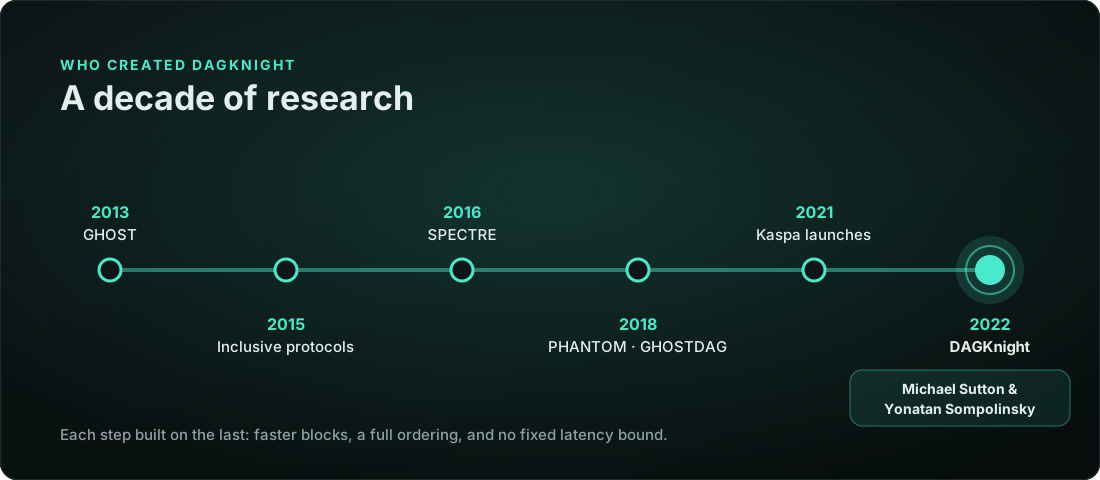
- 2013: GHOST. Sompolinsky and Zohar propose an alternative to Bitcoin's longest-chain rule in Secure High-Rate Transaction Processing in Bitcoin. Instead of counting only the main chain, GHOST also counts the work in competing blocks. Ethereum drew on the idea in its early design.
- 2015: Inclusive blockchain protocols. Lewenberg, Sompolinsky and Zohar propose letting blocks reference more than one parent, an early form of the blockDAG.
- 2016: SPECTRE. A blockDAG protocol designed for very fast payments. It was secure and didn't depend on a latency parameter, but it didn't produce a single, complete order of all transactions, which smart contracts and many applications need.
- 2018: PHANTOM and GHOSTDAG. Sompolinsky, Wyborski and Zohar describe PHANTOM, which orders the whole DAG by finding the best-connected cluster of blocks, and GHOSTDAG, a practical, greedy version of it. GHOSTDAG uses a fixed parameter, k, set from an assumed worst-case network delay.
- November 2021: Kaspa launches. Kaspa goes live as a fair-launch proof-of-work network running GHOSTDAG, with no premine.
- 2022: DAGKnight. Sutton and Sompolinsky publish DAGKnight, which combines PHANTOM-style total ordering with SPECTRE-style independence from a fixed latency bound.
Why DAGKnight was the next step
Each protocol fixed a limitation of the last:
- GHOST showed that discarded blocks still carry useful information about the honest majority.
- SPECTRE showed that a protocol didn't need a hard-coded delay assumption, but it couldn't give a full ordering.
- GHOSTDAG gave a full ordering and became practical enough to run Kaspa, but it relies on a fixed k chosen for the worst case.
- DAGKnight aims for both: a full ordering, like GHOSTDAG, without a fixed latency bound built into the protocol. Our parameterless consensus explainer covers how.
From paper to code
Publishing a protocol is only the start. DAGKnight is being implemented in rusty-kaspa, on a dedicated branch, with parts such as the tie-breaking rule in code review during 2026. It isn't live on mainnet yet. See our DAGKnight status update for the latest, and the upgrade tracker for every Kaspa fork.
Frequently asked questions
Did Satoshi Nakamoto have anything to do with DAGKnight?
No. DAGKnight builds on Nakamoto consensus, which Satoshi described in the Bitcoin paper, but it was designed by Sutton and Sompolinsky. See DAGKnight vs Bitcoin's Nakamoto consensus.
Is DAGKnight owned by a company?
No. The research is published openly, and Kaspa's node software is open source. Kaspa itself is a community-run network.
Where can I read the original paper?
On the IACR ePrint archive, linked in the sources below.
Not financial advice. This article is for education only. dagknight.com is a community project and is not affiliated with the Kaspa Foundation.