Blog
Yonatan Sompolinsky on Kaspa's "Holy Grail": Real Time Without Giving Up Decentralization
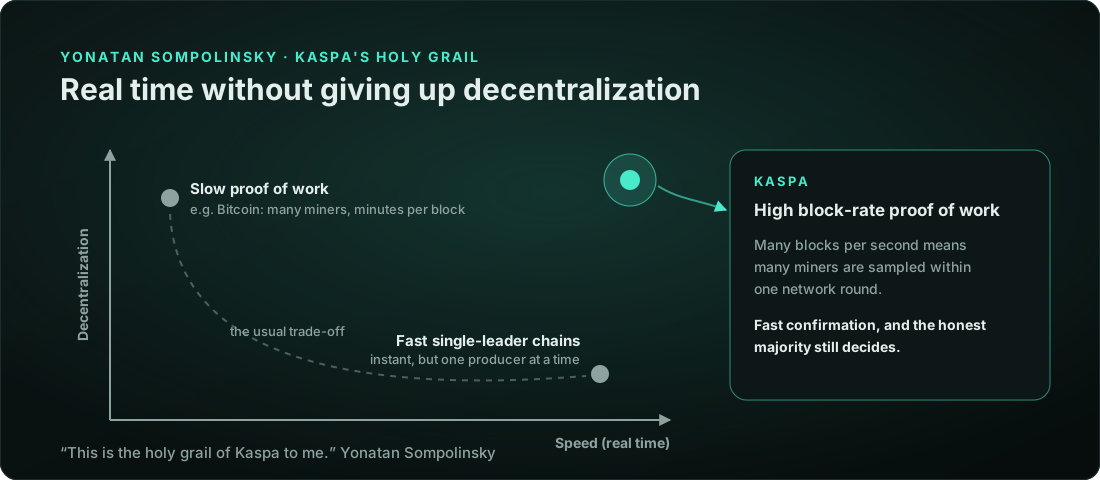
In a recent interview, Kaspa creator Dr Yonatan Sompolinsky set out what he sees as Kaspa's defining advantage. Most of crypto, he argues, forces a choice between being fast and being decentralized. Kaspa's high block-rate proof of work is designed to deliver both at once. "This is the holy grail of Kaspa to me," he said.
Watch the interview
The trade-off Kaspa is built to escape
Sompolinsky splits the crypto world into two camps. On one side are systems that are decentralized but slow, where you wait minutes for many independent miners to weigh in. On the other are systems that are fast but, in the short term, centralized, where a single leader produces each block.
"Most of crypto is either real time or decentralization," he said. "No one married these two categories."
He was careful with the word "centralized". He is not claiming that the validators of fast chains like Solana are controlled by one party. His point is narrower: during the few hundred milliseconds of any one interaction, you are in the hands of one or two block producers.
Why proof of work is the key
His argument rests on a difference between proof of work and proof of stake:
- Proof of work bundles two things together. A miner commits to the exact contents of a block before the work selects it. Choosing the transactions and being selected to produce the block happen in one act.
- Proof of stake usually separates them. A validator is chosen as the proposer first, then decides what goes into the block.
- Fast blocks mean many samples. At high block rates, many different miners produce blocks within a single network round. That gives you a sample of the network's honest majority in close to real time, rather than the word of one leader.
Censorship resistance in seconds, not hours
He used censorship as an example. If 80% of Bitcoin's hashrate refused to include your transaction, you would wait around an hour for an honest miner to find a block. On chains with block times of about ten seconds, it could still take a minute or so.
With many blocks per second, an honest miner comes along almost immediately. That is the "real time" half of real-time decentralization.
Bridges and oracles
Sompolinsky said the trade-off is felt most sharply when a blockchain needs information from the outside world, for example a bridge or an oracle reporting that an event happened.
Normally you either trust one fast attester, or you wait for several rounds of votes so that many parties have confirmed it. "Consider 100 blocks per second," he said: with that many blocks you can sample a large population of miners within one round, which "alleviates the trade-off between real time and decentralization."
Kaspa runs at 10 blocks per second today. A move toward 100 is a longer-term research goal; see our path to 100 BPS explainer.
A lean, fast settlement layer
For everyday use, he pitched Kaspa as a very lean, very fast settlement layer. Rather than deploying a permanent smart contract, you can lock coins under short-lived, one-time logic and get it confirmed within a few hundred milliseconds. Your coins stay governed by the UTXO model and your own keys.
This is what Kaspa's new covenants enable. They let a transaction carry conditions on how its coins can be spent, without a full smart contract platform.
AI agents and "hit-and-run" usage
Admitting it can sound "cringe" to mention, Sompolinsky said AI agents are a natural fit. Whether they act fully on their own or on behalf of a person, he expects agents to favour "hit-and-run" interactions: get in, settle something quickly, and get out, rather than being steered into a particular contract. Covenants with ephemeral logic are built for exactly that.
Where DAGKnight fits
The interview does not go into DAGKnight in detail, but the argument depends on it. Sampling many miners in real time requires higher block rates, and Kaspa's current consensus, GHOSTDAG, relies on a fixed assumption about network delay that becomes a constraint as blocks speed up.
DAGKnight, which Sompolinsky co-authored with Michael Sutton, removes that fixed parameter and adapts to the network's actual conditions. In an earlier interview he stressed that DAGKnight is "not faster per se". Its value is that it stays secure as the network pushes speed. See parameterless consensus explained.
What this means
- A clear pitch for Kaspa. Not just "fast proof of work", but the one place where speed and decentralization stop being a trade-off.
- Use cases to watch. Bridges, oracles, censorship-resistant payments and agent-driven, short-lived logic built on covenants.
- Still a roadmap. Kaspa runs at 10 blocks per second with GHOSTDAG today. DAGKnight is not on mainnet and has no activation date. See the DAGKnight Tracker.
Frequently asked questions
What does Yonatan Sompolinsky call Kaspa's "holy grail"?
Achieving real time and decentralization together, without the usual trade-off. Fast proof of work lets a blockchain sample many miners within one network round instead of trusting a single fast leader.
Why does proof of work matter for this?
In proof of work, a miner commits to a block's contents before being selected to produce it. With many blocks per second, many independent miners contribute in a short time, giving a real-time view of the honest majority.
Does Kaspa run at 100 blocks per second?
No. Kaspa runs at 10 blocks per second today. 100 is used as an illustration of where higher block rates could take the network, and is a longer-term goal.
Who is Yonatan Sompolinsky?
The computer scientist behind GHOST, PHANTOM and GHOSTDAG, and co-author of DAGKnight with Michael Sutton. See who created DAGKnight.
Not financial advice. This article is for education only. dagknight.com is a community project and is not affiliated with the Kaspa Foundation. Quotes are taken from the video's transcript and lightly cleaned up for readability.